

Executive remuneration remained a central focus of our engagement activities in 2025, against a backdrop of changing market practice and growing political and regulatory pressure on environmental, social and governance (ESG) considerations.

About Lilia Feghiu
Lilia Feghiu is Sustainability Analyst in the Impact Equities & Bonds team. She joined Triodos Investment Management in 2020. Prior to Triodos, Lilia worked at Sustainalytics where she was responsible for researching, analysing and rating the ESG risks and involvement of controversies of companies in the financial sector. Lilia holds a Master’s degree from Vrije Universiteit, Amsterdam.
While ESG-linked incentives remain common, particularly in Europe, recent developments indicate a reassessment of how, and whether, sustainability objectives should be reflected in executive pay. At the same time, rising levels of executive remuneration, especially in the United States, continue to test investor tolerance and raise questions about alignment with long-term value creation and stakeholder outcomes.
Building on our multi-year engagement project on executive remuneration, our discussions in 2025 focused on two themes. First, the scale and structure of executive pay, with maximum payout levels still rising. Second, whether remuneration frameworks genuinely support long-term strategy rather than short-term financial performance. Through dialogue with companies in our Impact Equities and Bond portfolios, including Procter & Gamble, Palo Alto Networks, as well as through voting where necessary, we sought to reinforce expectations around transparency, proportionality and business-relevant performance metrics, and to ensure that changes to pay structures do not weaken accountability on sustainability issues.
Say-on-pay as a key stewardship tool
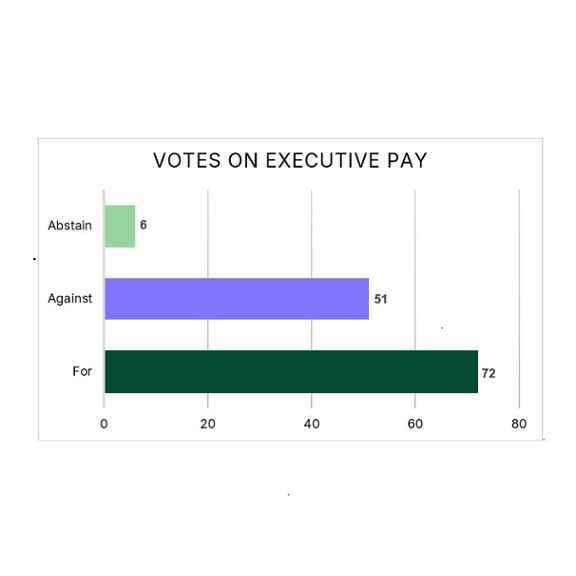
Say-on-pay votes remain a key instrument in our stewardship activities. In line with our proxy voting guidelines, we take a strict approach to executive remuneration. We vote against:
- remuneration-related resolutions where compensation levels are deemed excessive in absolute terms or relative to the wider workforce, including where CEO-to-median employee pay ratios exceed our thresholds.
- remuneration structures where less than half of the long-term incentives are performance-based, or where stock options are used.
- when governance safeguards such as robust clawback or malus provisions and double-trigger change-of-control arrangements are absent. Where environmental, social or human capital risks are material to the business, we expect these to be reflected in performance metrics, or for boards to clearly demonstrate how accountability for these risks is otherwise ensured.
ESG metrics under pressure
One noticeable development during the year was the removal or softening of ESG-related metrics in executive incentive plans, particularly among US-listed companies. This appears to reflect a broader shift in the perception and political framing of ESG in the United States, where increased scrutiny and polarisation around ESG topics have led some companies to distance themselves from explicit ESG-linked commitments. While it is too early to view this as a clear trend, recent market data indicate that several companies have reduced or removed certain ESG elements, such as diversity, equity and inclusion metrics, from their remuneration schemes. Whereas our engagement approach does not assume that every ESG topic must automatically be linked to pay, we do expect boards to clearly explain how accountability for material sustainability and people-related risks is otherwise ensured when such metrics are removed. In our view, linking pay to ESG outcomes is most effective where metrics are clearly defined, quantifiable and transparently reported, rather than based on broad or discretionary measures without specific key performance indicators.
Procter & Gamble removes ESG metrics
Procter & Gamble announced that, from FY 2025-2026 onwards, it will no longer apply an ESG modifier to its short-term incentive programme, stating in response to our questions that the metric had fulfilled its purpose of embedding ESG considerations into management decision-making. Our engagement with Procter & Gamble focused on whether the removal of explicit ESG metrics reflects genuine integration of sustainability into the company’s strategy, or whether it risks weakening accountability.
Excessive pay and shareholder pushback at Palo Alto Networks
The year 2025 also highlighted growing shareholder resistance to very large executive pay packages. Palo Alto Networks is a case in point here. Following significant opposition against its executive compensation plans at the 2024 annual general meeting, we engaged with the company to discuss the drivers of shareholder dissatisfaction.
Looking ahead
In 2026, we will continue to engage with the companies in our Impact Equities and Bond portfolios to support good pay structures, focusing on pay levels, incentive design and ESG risks. Variable pay should be genuinely linked to performance. Incentive metrics should be material, transparent and measurable. Boards should exercise restraint when it comes to discretionary awards and extreme payout outcomes. Where ESG metrics are included, they should be clearly linked to business strategy and supported by meaningful targets. Where such metrics are removed, boards should demonstrate how sustainability risks continue to be governed and managed.
We will acknowledge progress where companies make positive changes. If concerns remain, we will use our votes and other tools to encourage better alignment between executive pay, long-term company performance and broader societal goals.