

The world economy seems remarkably resilient. If you look only at the headline figures that is certainly true. But growth is a flow. It tells you how fast the machine runs compared with last year. That says little about the state of the machine. You might be revving the engine on an old car one day, only for it to fall apart on the next day.
Four pressures, one system
Four long-term trends became top of mind in 2026: climate change, AI, geopolitics and public debt. They will also shape 2027 and beyond.
- Climate change
Climate damage has moved beyond stress tests and has become economic reality. Our Hot Summer Economics analysis estimates that this summer's heat cost the EU around EUR 180 billion, mostly through lost labour productivity. Heat killed more than 50,000 people in Europe's cities. And 2027 will probably be worse. The WMO expects the current El Niño to become very strong around the turn of the year, adding to a warming trend that is already breaking records. Meanwhile, the European Commission has told member states to prepare for 3°C of warming by 2100. A realistic assessment, perhaps, but also a damning if quiet farewell to the climate goal of 1.5°C. - AI
AI helps explain why growth held up nonetheless. Big Tech is expected to spend about USD 1 trillion on capital expenditure this year and we expect hyperscalers to spend a further USD 1.8 trillion in 2027. For now, growth is being driven by the investment spending itself. Revenues will need to follow for these investments to pay off. Whether these revenues will materialise, and whether they will come from increased production or labour displacement remains an open question. Estimates of AI’s contribution to annual growth offer little certainty: they range from less than 0.1 percentage points (Acemoglu) to 1.5 annually (Goldman Sachs). The reality is that nobody knows at this moment. AI’s footprint, however, is more predictable: the IEA expects data centres’ electricity use to double by 2030, to slightly more than Japan’s entire current consumption. - Geopolitics
Geopolitics has shifted from rules to power. The Peace Research Institute Oslo counted 65 state-based armed conflicts in 2025, the highest number since 1946. Military spending rose for the eleventh year in a row, to USD 2.9 trillion. The average US tariff stood at 11.1% in July, its highest level in decades. And the Strait of Hormuz showed how quickly resources can become weapons: the closure of the Strait simultaneously provided an oil shock and a fertiliser shock, and therefore a food shock. - Public debt
Lastly, the fiscal room many economies once had, has largely disappeared. According to the IMF, global public debt is heading towards 100% of global GDP by 2029. Long-term yields are at multi-decade highs, and more and more countries are paying an interest rate on their debt that is higher than their growth rate. When interest rates exceed growth rates, debt ratios rise even if a government manages to balance non-debt related spending with taxes. This sets in motion a spiral of shrinking fiscal space.
Advanced Economies Outlook 2027: Growth for the few, power for the fewer
Each of these trends receives plenty of attention, but usually as a separate risk or development, with a focus on only some of their effects.
The public pays
Yet they are four sides to the same system, and every shock ends up in the same place: the public balance sheet. Climate damage hits public finances and leaves governments with less room to act. They dilute climate policies, thus increasing exposure to further damage. AI is presented as a fix for weak growth, yet competes with governments for the same pool of savings. Since 2024, hyperscalers’ share of global investment-grade bond issuance has risen from less than 1% to around 10%, putting further pressure on long-term rates. Geopolitical tensions bring defence spending and fuel subsidies. And beneath it all, eroding trust shortens every policy horizon, while these problems demand long ones.
The four also share a root. The system they act on is running out of growth. Although there is still headline growth, many people experience it as stagnation. Incomes, health, the sense of progress: for many, all three have stalled.
In the US, a booming economy goes together with falling consumer confidence. When the pie stops growing, or grows unevenly, politics often turns zero-sum. Benjamin Friedman showed already decades ago how stagnation erodes openness and tolerance. The V-Dem Institute found that nearly a quarter of all countries became more autocratic in 2025, six of the ten new cases in Europe and North America.
Stagnation feeds trade wars and blame aimed at migrants and other countries. Defence becomes the one expense nobody argues about, and long-term investment and social spending give way. AI fills the gap.
Nobody knows what it will do to growth, productivity or inequality, and that uncertainty is exactly what makes it useful: a promise of escape that cannot yet be disproven. Climate mitigation, the threat that matters most, moves to the back of the queue.

Emerging Markets Outlook 2027: Taking on the challenge of wars, AI and climate risk
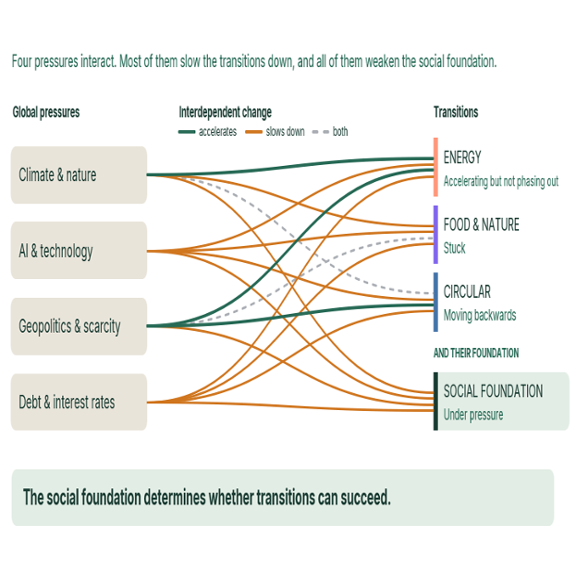
Global pressures, different transitions
Stability bought with time
So, if these four trends tie together in such a worrying pattern, then why does the economy keep growing? Because postponement works. A destabilised system can superficially look very stable, until it cracks.
Each pressure got a ‘solution’ that protects the existing system first, and most of those ‘solutions’ add to GDP for now. Climate: adapt, delay, dilute. Adaptation spending counts as growth; the cost of delayed mitigation comes later. AI: subsidies and lighter regulation. Geopolitics: defence, stockpiles, self-sufficiency, all of it spending today. Debt: cut spending where resistance is lowest, usually long-term investment.
Sociologist Wolfgang Streeck calls this buying time. The bill keeps growing: on balance sheets, in the atmosphere, in the trust between citizens and institutions.
In our economic outlook for 2023 Resilience in times of polycrisis we warned against too much ‘fortress resilience’: building buffers that absorb the next shock and keep the old system standing, while the capacity to transform to sustainable systems gets the least attention and the least funding. That is exactly what is happening now.
Ecologists are familiar with the pattern. A system approaching a tipping point may look stable on the surface while underneath its resilience declines. It takes longer to recover from each shock and its buffers are gradually depleted.
GDP keeps signaling that all is well, but there are warning signs elsewhere: bond yields refusing to come down, insurers withdrawing from exposed regions and growth narrowing to a handful of countries and companies. And instead of recognising the unsustainability of this economic system, we allow the four trends to accelerate its demise.
Financial markets’ time horizons
Meanwhile, financial markets run on two clocks. The long clock measures whether prices reflect the risks outlined above. The short clock tracks liquidity, momentum and the next earnings season. In 2027, the two may point in different directions for a while.
On the long clock, current pricing is hard to reconcile with any of the four trends. According to JPMorgan, AI-related stocks make up around 49% of the S&P 500's market value. Only the railways in the 19th century weighed more as a single theme.
The ten largest companies account for close to 40% of the index, the highest concentration since 1965. This comes down to a single bet: that one technology will deliver, on time and at scale, despite the pressure on electricity grids, the high interest rates and the growing political resistance. Even if AI delivers, today’s valuations may not survive. Railways crashed too, useful as they were.
Climate risk is mispriced twice. Real estate in flood plains and farmland in drying regions are overvalued if damage accelerates, as the European Commission now tells member states to plan for. They are overvalued again if policy catches up.
Real estate has a second problem: interest rates. The term premium, the extra yield investors demand for holding long-term bonds, can rise further as debt ratios climb and hyperscalers compete for the same savings.
That is where the IMF’s central downside scenario begins: a sharp, disorderly rise in sovereign yields that hits bonds, AI equities and the collateral holding the financial system together. All at once. A risk-free rate is only risk-free if the issuer stays solvent and politically stable.
But on the short clock, the rally could last. As long as AI investment flows, chipmakers and cloud providers can keep growing earnings. If oil supply recovers, inflation can ease, giving central banks more leeway to lower rates. That would help relieve pressure on government budgets.
Defence spending and industrial policy are also adding to demand, sustaining growth. The dot-com bubble ran for years, and so could AI. This is what you see reflected in our 2027 outlook.
For 2027, we expect higher volatility and a widening gap between headline market performance and the breadth of the rally. The most likely trigger for a larger correction is a combination of disappointing returns on AI investments and higher yields, or an energy or climate shock amid stretched valuations. For long-term investors, the case for diversifying away from a handful of US tech companies is strong.
Transformability
In 2023, we distinguished six shades of resilience. Four make a system harder to break: redundancy, diversity, dispersity and autarky. They buy time. They cannot change direction. Only two help the system change: adaptability and transformability.
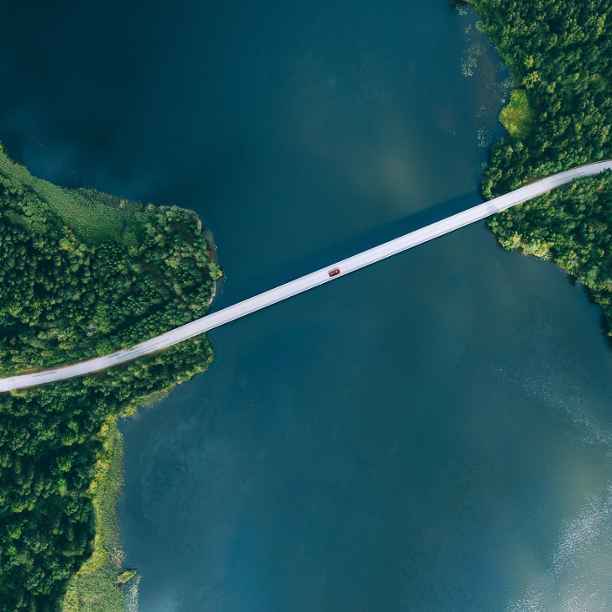
Today, almost all the money and attention go to the first four. The fortress buys time on the old shore. Transformability builds the bridge to the other side. Building that bridge means four interconnected transitions:
- Energy
- Food
- Nature
- Circular economy
Only energy is moving because clean power is cheaper than fossil. Food, nature and the circular economy remain stuck because they have to compete with damage nobody pays for. Getting these four interconnected transitions unstuck sets the long-term agenda, and it asks something different of each actor.
We can change
It feels like one crisis after another. But a crisis passes, and this will not. Waiting for recovery is pointless and postponement is the most expensive choice on the table. This is not a crisis. That is why we can change.